

A commercial box gutter is a deep, rectangular metal trough that carries far more water than a standard K-style gutter, which is why storefronts, metal buildings, and patio awnings use it. Premium Leaf Guards fabricates and installs steel box gutters in Ocala, sized to Florida’s heavy summer rain, seamed tight, and hung to last. A state-licensed building inspector is on every job.
If the gutter on your building overflows in a hard rain, leaks at the corners, or rusted out years before it should have, the trouble is almost always that it was undersized, under-hung, or made from metal too thin for the job. We build box gutters the right way: heavy steel, seamed tight, hung every two feet, and sized to the roof it actually has to drain. You deal with the owner, a state-licensed home and building inspector who is on every job and tells you straight what your building needs and what it does not.
A box gutter is exactly what it sounds like: a square or rectangular trough instead of the rounded K-style gutter most homes have. That boxy shape is the whole point. At the same width, a box gutter holds a lot more water than a K-style, so it is what you put on a building that has to shed real volume in a hurry. Storefronts, metal buildings, warehouses, pole barns, and the wide patio awnings you see all over Central Florida were built for box gutters, not five-inch residential ones.
The other difference is what it is made of. A commercial box gutter is usually formed from heavy 24-gauge galvanized or Galvalume steel, or from thick .040 aluminum with a baked-on finish. That heavier metal is what lets it span a long run, carry the weight of a hard rain, and stand up to the sun for decades instead of denting and rusting in a few seasons.
Done right, a steel box gutter is the toughest gutter on the building. Done wrong, it is the first thing that fails. The difference is in how it is sized, seamed, and hung, which is where most of them go bad.
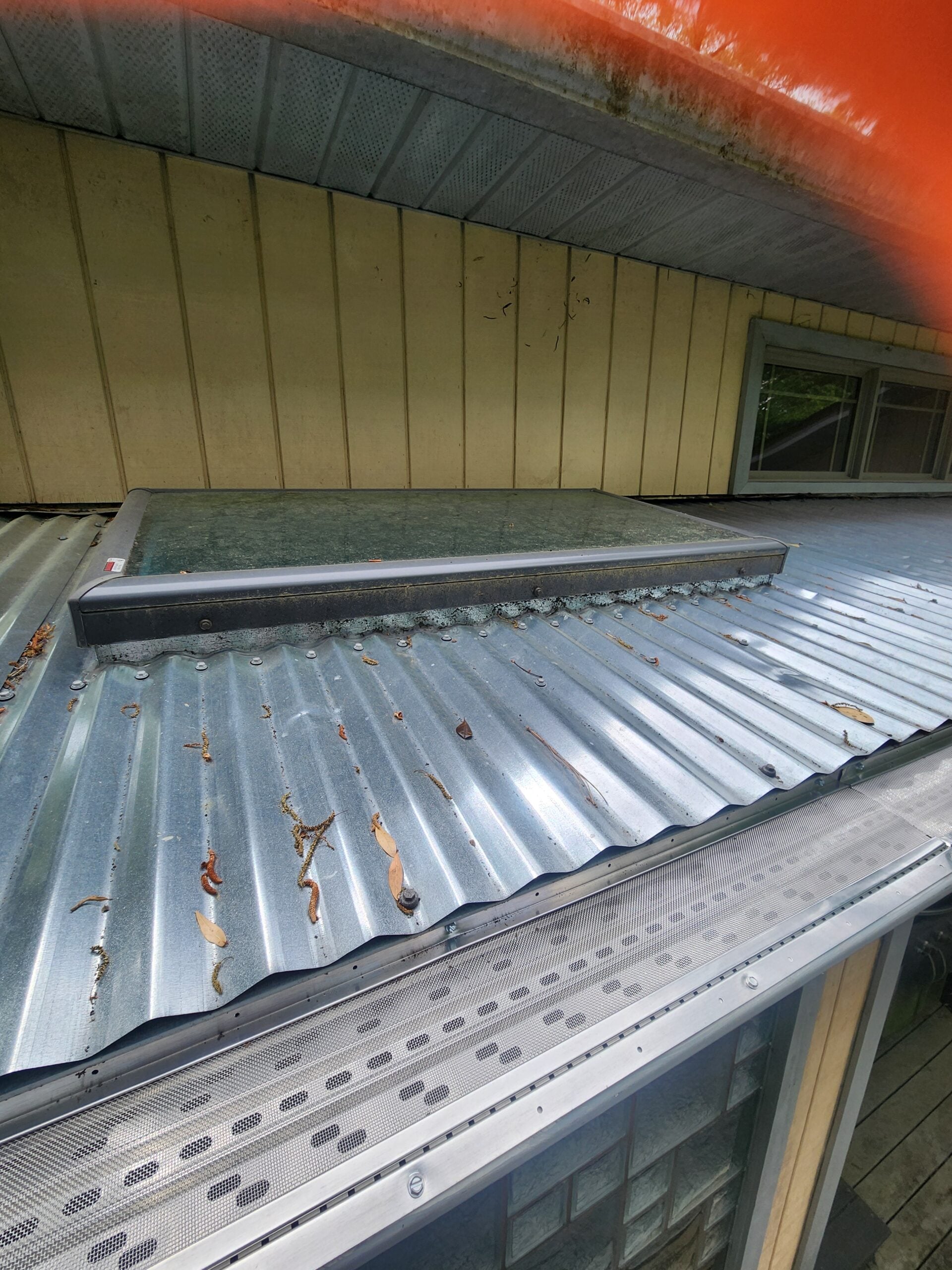
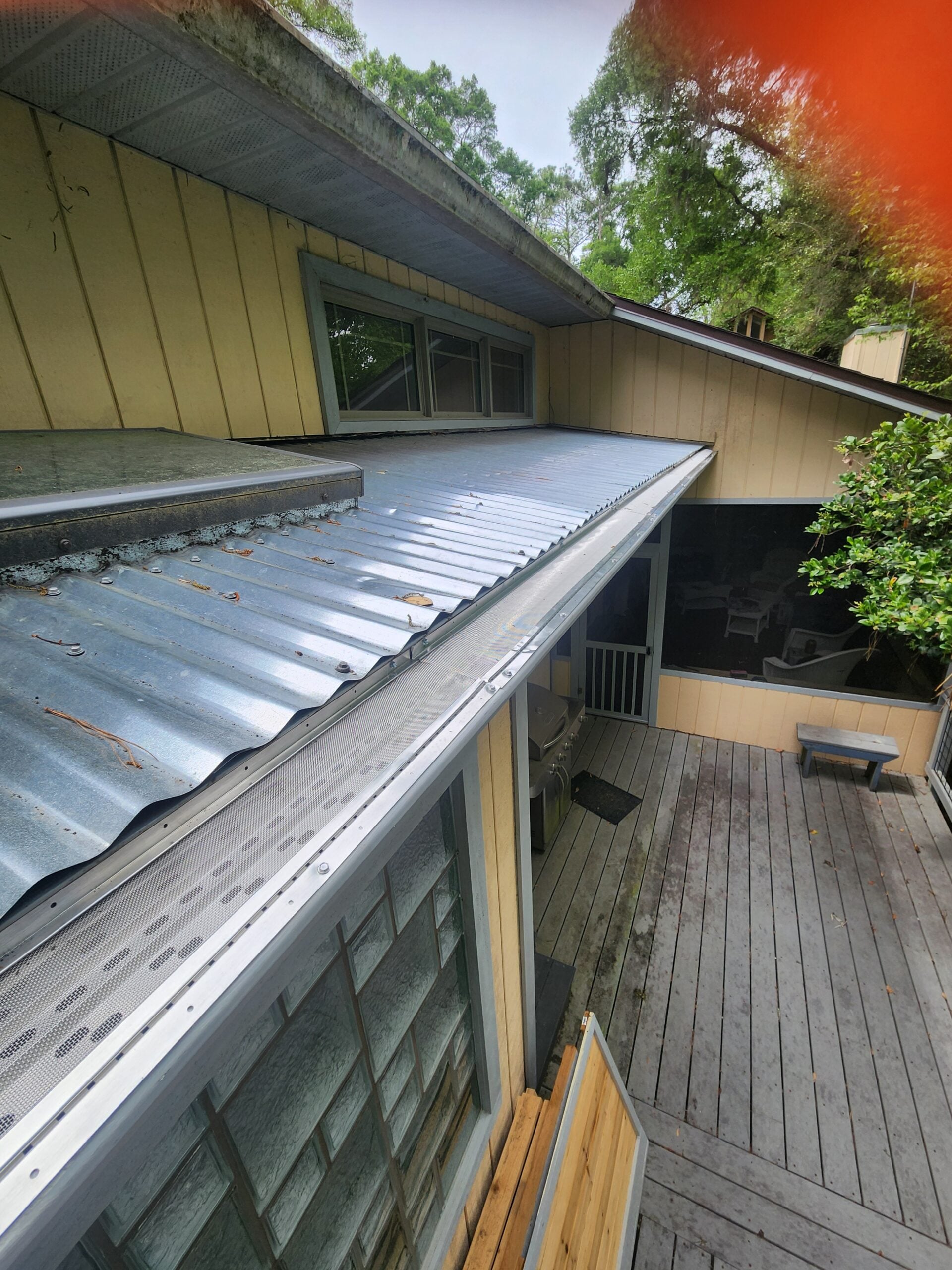
If you own one of these and the water is not behaving, a box gutter is probably the right answer:
One honest note up front: we install and service box gutters on one- and two-story buildings. If your building is taller than that, we are not the right crew, and we will tell you so instead of taking a job we cannot do safely and right.
Almost every failed box gutter we are called out to look at went wrong for one of four reasons, and all four are avoidable.
Somebody put a residential-size gutter on a commercial-size roof. When an Ocala summer storm drops two inches in an hour, the trough fills, the water has nowhere to go, and it pours over the front lip.
A box gutter can be plenty big and still flood if the water cannot get out fast enough. The rule we build to is a downspout about every twenty to thirty feet. Skip them to save money and the run holds standing water, sags at the joints, and starts to leak.
A gutter needs just enough fall to move water toward the outlets. Hang it dead level or backward and water pools, sits, and rusts the metal from the inside out.
Light-gauge steel with hangers spaced wide bends, pulls loose, and opens up the seams.
The honest stakes: a box gutter that overflows does not just annoy you. It runs water down the wall, rots the fascia, stains the storefront, and pools at the slab. Fix it cheap once and you pay to fix it again. Build it right and you stop thinking about it.
We start by measuring the actual roof that drains into the gutter, not by guessing. That number tells us how wide the box gutter has to be and how many downspouts it takes to clear the heaviest rain your building will see. In Ocala that matters, because we average about fifty-two inches of rain a year, most of it in fast summer storms that dump six to eight inches a month.
Then we build it like it has to survive that:
We use 24-gauge galvanized or Galvalume steel, or thick .040 aluminum with a baked Kynar finish. That is the metal that lasts thirty to forty years instead of denting and rusting early.
Box-gutter joints and corners are where leaks start, so we seam and seal them properly instead of smearing caulk over a gap.
Florida practice allows spacing up to about three feet. We set them every two so the run does not bow, pull loose, or open up when it is full of water.
We size and place the outlets so water leaves fast, and we give the run the fall it needs to drain instead of pooling.
Where it helps, we drop the downspouts into solid PVC and carry the water about five feet from the building, instead of dumping it at the foundation.
I am Jeff Ours, a state-licensed home and building inspector with more than twenty years in construction. I read buildings for a living, so when I size a box gutter I am thinking about the whole system: the roof area, the rainfall, the wall behind it, and where the water has to end up. I am on every job, and I do about half the install myself, because the system is only as good as the installer.
I believe in over-engineering things and doing them to current codes. I like money, but I am not going to sell you something your building does not need. If a standard gutter does the job, I will tell you that too.

Call or text and describe the building and what the water is doing. New work gets a free estimate. If you need us to diagnose an existing system, a $100 diagnostic visit applies and is credited to the job if you hire us.
We look at the roof area, the rainfall it has to handle, and the wall and foundation behind it, then price it all-in with no surprises.
We fabricate, seam, and hang the box gutter to last, get the water away from the building, and back our work with a 2-year workmanship warranty.
We install and service commercial box gutters across Ocala and Central Florida, including Marion, Lake, Sumter, Alachua, and Putnam counties, with The Villages a regular stop. If you own a one- or two-story building anywhere in the area and the water is not getting where it should, we can come look.
It is a deep, square or rectangular metal trough used in place of a rounded residential gutter. The boxy shape carries much more water at the same width, so it is the standard choice for storefronts, metal buildings, warehouses, and wide patio awnings that have to drain a lot of roof in a hurry.
Yes. Because of the boxy profile, a box gutter holds noticeably more water than a K-style gutter of the same width. That extra capacity is exactly why commercial and large-roof buildings use them, and why putting a small residential gutter on a commercial roof is a recipe for overflow.
A box gutter built from heavy 24-gauge steel or thick .040 aluminum with a baked finish, hung and pitched correctly, commonly lasts thirty to forty years. The ones that fail early were usually undersized, made from thin metal, or hung too far apart.
Most overflow and leaks come down to four things: the gutter is too small for the roof, there are too few downspouts, the pitch is wrong, or the seams were never sealed properly. We measure the roof and rebuild to fix the actual cause, not just patch the symptom.
A good rule is about one downspout every twenty to thirty feet, with the exact number set by the roof area and the rainfall it has to clear. Too few downspouts is one of the most common reasons a perfectly large gutter still floods.
We install and service box gutters on one- and two-story buildings. If your building is taller than that, we are not the right crew for it, and we will say so up front rather than take a job we cannot do safely and right.
Tell us about your building and what the rain is doing, and we will size it right and price it all-in. A licensed building inspector is on every job, and we build it to last the first time.